
This essay first appeared as the forward to the monograph Alex Kanevsky Paintings 2003-2022, published by Dolby Chadwick Gallery in September 2023.
A draped form, a field of grass, a bath, a running dog. Peeling wall or crashing wave. Skin, space, sensation. Distillation, escalation, suspension. Sifting and shifting enchantment. Our eyes are transfixed by the kaleidoscopic tableaux of Alex Kanevsky.
In Kanevsky’s paintings, the gaze is ever-present. There is an intimacy of observation. Perhaps this is the quintessence of a Kanevsky painting: the desire to see and be seen. He is honoring a distinctly human yearning for connection. One does not merely glance at a Kanevsky painting; one enters it. A kinetic exchange occurs. The frisson of closeness lingers.

Over the past two decades, Kanevsky has brought us numerous windows into the human figure. Whether lying on a bed, turning away, sharing a meal, or riding a horse, his models seem one with their surroundings. Ironically, it is through Kanevsky’s mode of blurring, blending, and refracting that they seem to be made whole. Interior and exterior are made mutable. Subject and environment exist in a shared space. Color and marks flow like air, light, and water to bind the animate with the inanimate.

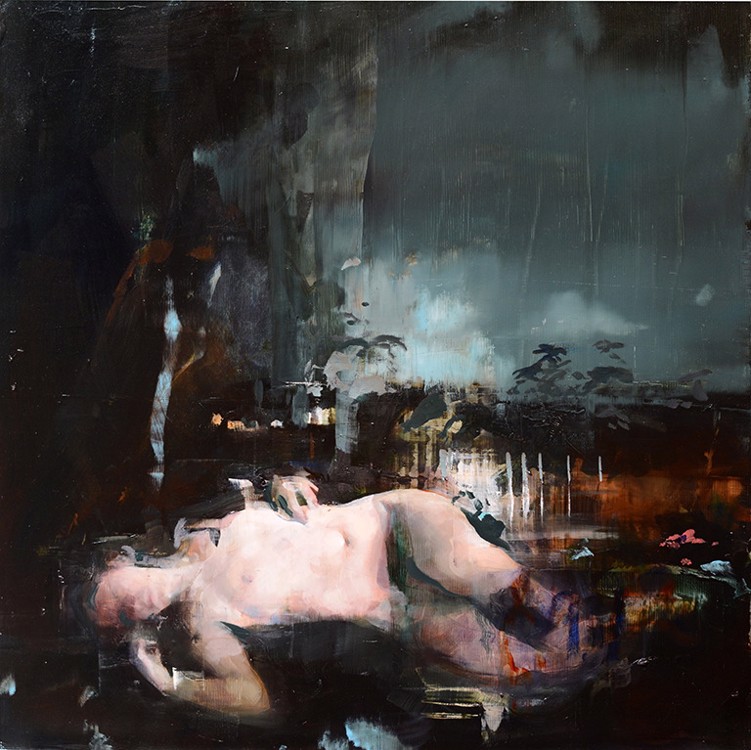
Kanevsky’s paintings ask more questions than they answer. “Night, 2015” presents a woman lying on her side, her face obscured. She may be awake, or she may be asleep. Is she under the night sky or dreaming it? Is the illumination a natural shimmer on the surface of a lake? Are those small squares suggestive of windows? It is exactly these questions that compel and excite. Throughout, there is a tensile force at work. Counterpoints of serenity and wildness swim before us.
Kanevsky’s paintings diffuse and expand their enigmas with a strange liquid beauty. They can be musical in their pace changes and tone harmonics. They are poetic in their line breaks and remixing of painterly language. There is also a geometry at play, wherein Kanesky’s training in mathematics is translated visually into compositions that transcend their equations. “J.F.H. Four Times” and “Twins’ Bath” are but two examples. The link between music, math, and verse (and maybe the irrelevance of such subject matter distinctions) is captured in Kanevsky’s fugue-like wave series, the symphonic “Dinner on the Battlefield” and the operatic “Interior with Meat.” One can almost hear these paintings as much as see them.

In addressing the female nude, Kanevsky’s paintings forge a trust between his model and his audience. They “reform” a mode of painting that throughout history was often objectifying to women. Take “JH, 2020,” in which vibrant orange falls across the bed. Is this a serendipitous wash of sunlight or an intrinsic part of the fabric? Its appeal almost distracts us from the fact of the nude form just behind. There’s a certain physical thrill one gets from the intensity of the gesture, as though the painter is tossing us a gorgeous bolt of color. We are at play in this scene. The body becomes innocent. And if we viewers are voyeurs, it is only to the act of painting itself.
A Kanevsky painting is always an experience. Consider the unexpected provocation of “Friends with a Bird, 2020.” How is it that a painting of two naked and entwined women on a bed, both of whom hold the eye of the viewer, manages to distract our attention with the small unframed picture of a turkey on the wall above them? The turkey becomes intrinsic to the scene. It is complicit in our surveillance but also, one has the sense, to the success of the composition and assignation itself. It is an astounding counterpoint to the nude embrace.

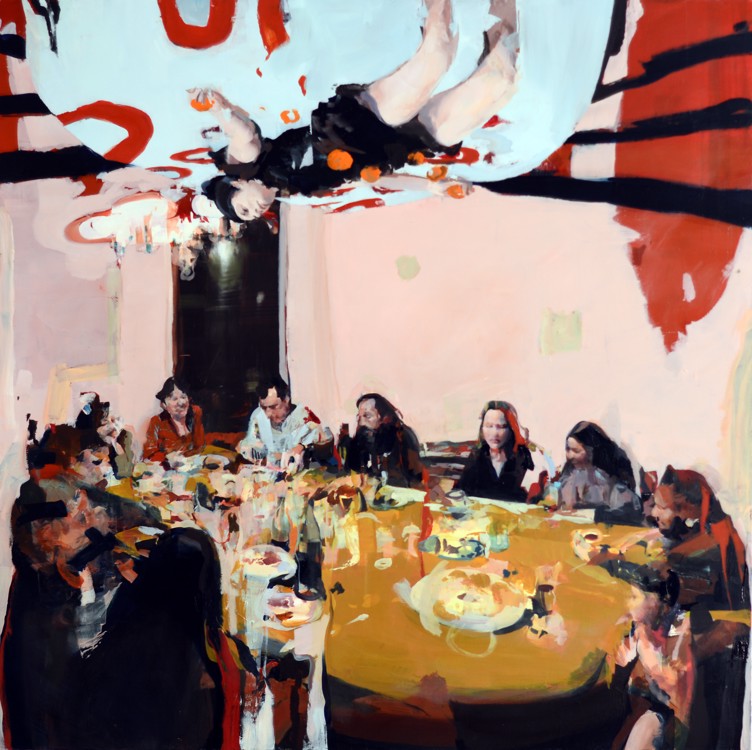
Though the majority of work focuses on centralizing individual or duet, there are many compositions in which a larger group of people appear. “Dinner with Dear Friend, 2020” shows a meal underway in the bottom half of the painting. The upper realm contains the scene of a woman lying on a large ottoman with oranges in her hands, at her sides, and across her lap. The spectacle is upside down from the perspective of the party goers; it’s as though she’s floating above them. But if the painting is spun around, it is the diners who levitate from the ceiling and we notice what may be a face, a light, and even a serving tray coming through the dark space of another room behind the supine woman. This strip of darkness is what connects both scenes. Is the woman above dreaming of the people below or is she being dreamed of or discussed by someone or everyone at the party? The painting’s mystery is much like the labyrinthine riddle of a Jorge Luis Borges tale. Here we witness the pattern of Kanevsky’s mind. Delusion, illusion, or inversion are infinitely more interesting than what poses as everyday reality.
The question of how human beings decide what is real has fascinated philosophers, scientists and artists through the ages. Atoms are so much smaller than the wavelength of visible light that they are technically invisible. Their jittery dance is made observable by the collision of individual water molecules on particles of dust. This opens up the time-lapse quality of Kanevsky’s paintings to the notion that they may approximate the unfolding of secret interwoven actualities. This is certainly how it feels to experience them. As Kanevsky himself has said: “People are defined by their movements, they are not defined by their shape. Place — it changes all the time, so if you want to paint people you have to incorporate the movement into your paintings.”
These remarkable paintings are provocative. They are sublime. They take up residence and expand. They cast a unifying light upon even the most quotidian of scenes, objects, and poses. They can feel epic. They can feel Edenic, particularly when Kanevsky unites ancient greens, glowing flesh, and crystalline blue. He captures moments that are heartbreakingly lovely for being so vanishingly alive.
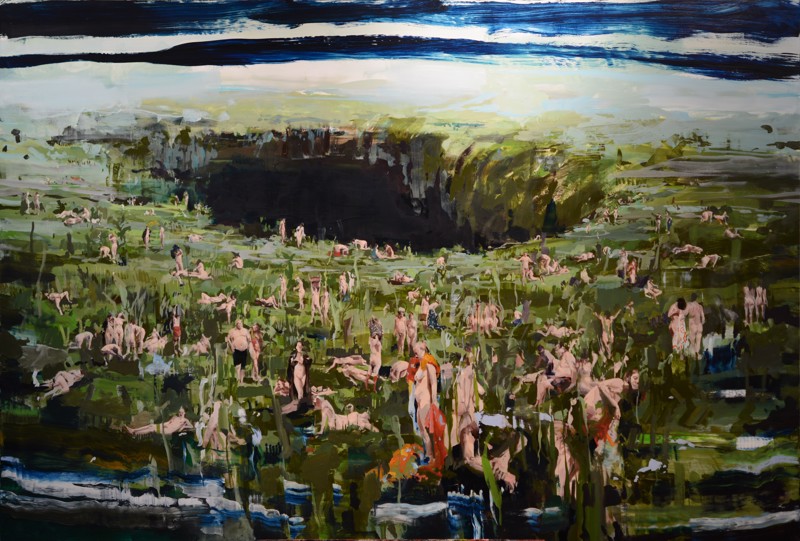
Which is the garden from which we cannot fall? Is it the paradise of a “Breakfast on the Grass, 2020” which nods to Édouard Manet and Claude Monet’s echo, or is it the scene of Boschian bacchanalia in Kanevesky’s Garden of Earthly Delights and Disappointments, 2022? Always, we are called to wonder.
The Russian novelist Vladimir Nabokov was a brilliantly inventive prose stylist with a wry sense of humor. His novel Pale Fire presents a 999-line poem written by a fictional poet, followed by an extensive metafictional index and running commentary written by a delusional fictional critic. These interconnected layers refract in multiple directions. The writing is as witty as it is profound. The opening lines of the poem conjure the image of a bird hitting the “false azure” of the windowpane. The poet imagines that the bird can fly on (and live on) and that he too transpose existence to the other side of the looking glass:
And from the inside, too, I’d duplicate
Myself, my lamp, an apple on a plate:
Uncurtaining the night, I’d let dark glass
Hang all the furniture above the grass….
There is a kinship in the approach of these two countrymen. Kanevsky too inverts, rearranges, and teaches us an alternative way to see our place in the world and all that surrounds us. The dynamism of Kanevsky’s technique may be not only an indication of the restlessness of time and light but also a mechanism to release the aforementioned kinetic exchange. The paintings affect a twinning between the viewer and the viewed.

A particular glimpse of this communion is offered in Winter Party in 2020. It captures a moment in time when rare sips of human contact felt fragile and precious. The painting is melancholy and exuberant in equal turns. Kanevsky invites us into this crystal land. We fly towards its reflection. We raise a glass. It is solid. It is melting.
 Tamsin Smith : everything indicates